

Shift: Managing Your Emotions—So They Don't Manage You
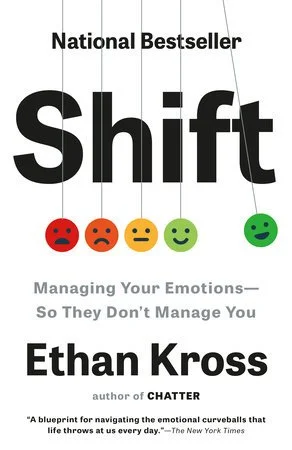
THE VOICE TELLING YOU TO “JUST CALM DOWN” HAS BEEN MAKING THE PROBLEM WORSE.
Ethan Kross's book Shift lands on something most high-performers miss: emotions are information, not problems to solve.
When they show up at the right intensity and the right time, they work like an immune system. They alert you, help you react, guide your choices. But when they're too intense or last too long, they take over. You spiral, react, and lose the clarity you need.

The core premise: emotions are data, not verdicts.
The goal is learning to shift—experience all of them, learn from them, and when needed, move from one state into another.
The shift from conventional wisdom:
Most people think emotions are good or bad.
That avoidance is always toxic. That you should suppress negative feelings.
Kross dispels these myths. Emotions are information. Tactical distraction works. Sometimes you need to step away to come back stronger.

Why learning to shift changes everything:
Better outcomes everywhere
People who regulate emotions well do better in relationships, work, health, and life satisfaction. They recover from difficulty. They amplify what feels good.Your emotions affect everyone around you
How you manage fear, sadness, worry directly impacts the people near you. Your nervous system regulation becomes their nervous system regulation.You control the trajectory
You can't control what triggers an emotion. But you can control how long it lasts and where it takes you.The tools are already here
Kross shows you already have everything you need—in your body, mind, relationships, spaces. You just need to know how to use them.
Emotional Management Is Nervous System Work
Kross talks about emotional management. In Vitality Architecture terms, this is working with your biology instead of against it. Emotions are information. Fear means threat. Anger means boundary crossed. Sadness means loss. Getting stuck too long is the problem.
High-performers override these signals. Push through fear, suppress sadness, intellectualize anger. And the result? Chronic activation. Lost curiosity, creativity, connection.
Kross teaches how to shift emotional states instead of staying stuck. This is partnership with your biology. Listen. Respond. Come back into alignment.
Don't have time to read it? Here's what you need to know:
Emotions function like an immune system when activated correctly. They take over when too intense or lasting too long.
Emotional management is not suppression. Experience emotions, learn from them, shift when needed.
People who regulate emotions well recover faster and amplify the good. Better relationships, work performance, health, life satisfaction.
Your emotions spread. How you manage them affects everyone around you.
You control the trajectory, not the trigger. What you do after an emotion appears determines everything.
Seven Tools Kross Teaches
-
Your emotions connect deeply to sensory experience, often below conscious awareness. To shift emotions, add sensory experiences that move you in a different direction.
Feeling lonely? Put on happy music. Walk barefoot. Watch a sunset. Taste something delicious.
This is bottom-up regulation. You're using your body to signal safety to your brain. Your Creature responds to sensory input faster than your Executive can think.
-
Chronic avoidance harms. Tactical distraction helps. Most emotions are short-lived and fade with time. Distancing yourself helps you avoid reacting in ways you'll regret.
Walk away from a conflict. Pick up a novel. Give your nervous system time to settle before you respond. This is giving your Creature time to metabolize activation before your Executive decides.
-
Reframing an upsetting experience tones down emotional reactivity. Your wife shows up late to dinner. Instead of assuming disrespect, consider she got kept late by her boss.
Kross's shortcut: talk to yourself as if you were someone else. This "self-distancing" helps tone down problematic emotions. In parts work, this is your Executive talking to your Creature with compassion instead of criticism.
-
Your outer circumstances constantly affect your emotions. Change them deliberately to shift emotional reactions.
Stressed about work and unable to focus? Take a short walk in nature. Add things to your space that soothe you. A photo of someone you love. A flowering plant on your desk.
This is recognizing that beauty is biological code. Your nervous system reads certain environments as safe.
-
You need people who blend empathic support with good advice. Too much empathy without perspective adds fuel to your emotional fire. Too much advice without empathy makes you feel unheard.
This is finding people who help you regulate and help you think. Your Creature needs to feel seen. Your Executive needs perspective.
-
Cultural backgrounds affect how you feel about emotions and handle them. Find a culture that supports your emotional needs. Religious group. Sports team. Therapy group.
Your environment is part of your regulation system. You can't regulate alone in a culture that pathologizes emotion.
-
When you're overwhelmed, it's hard to reach for these tools. Practice them in less charged situations first.
This is patterns over willpower. Build capacity in green zone so you have access to it in yellow zone.
